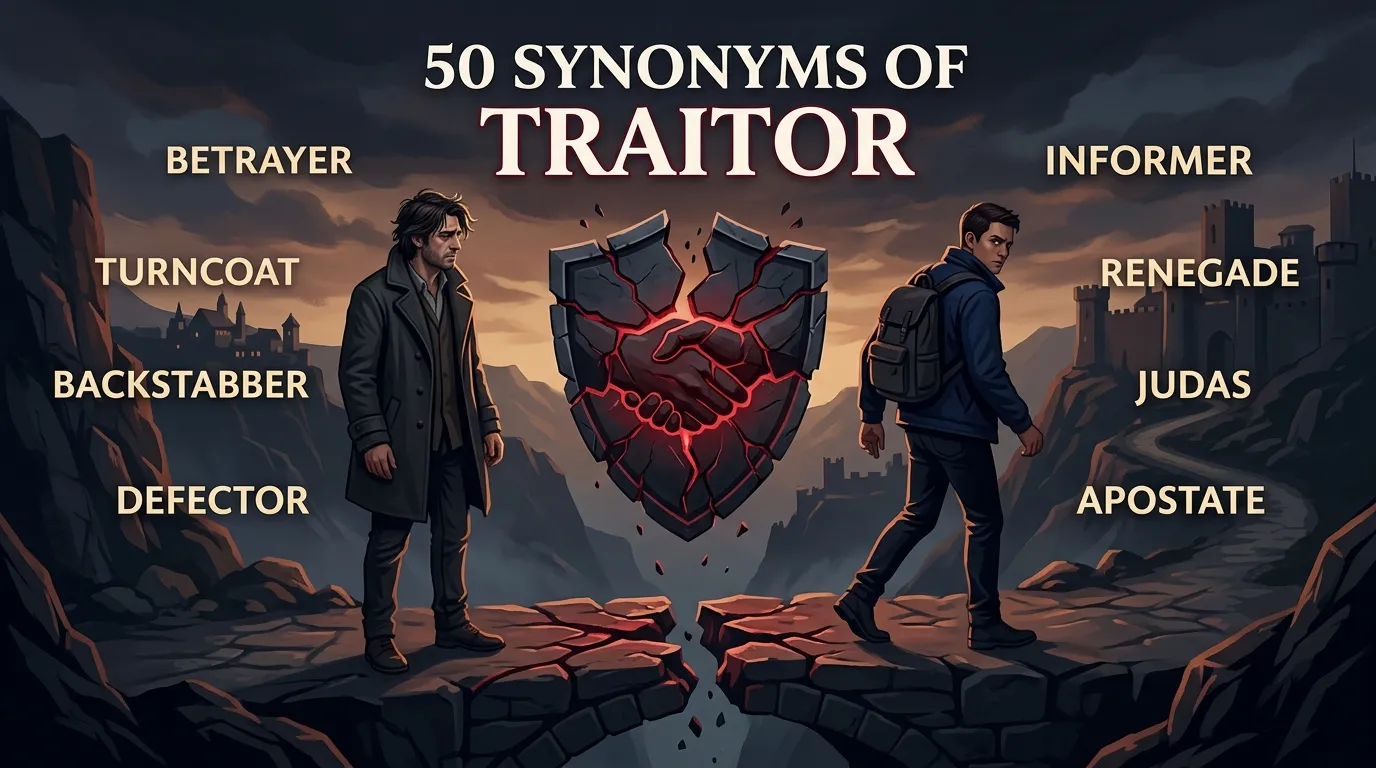
Have you ever needed a stronger word than traitor? Maybe you are writing an essay, a story, an email, or a social media post. The right word can make your message clearer.
The phrase synonyms of traitor means words that have the same or a very similar meaning as traitor. A traitor is a person who breaks trust or turns against a person, group, cause, or country.
For example, if a trusted friend secretly helps your rival, you might call that person a betrayer or backstabber. Some words are formal, while others are casual or emotional.
Learning these words helps students, bloggers, content writers, and daily English users choose the right word for the right situation. It also makes writing more interesting and precise. Major thesaurus sources list words such as betrayer, turncoat, renegade, defector, double-crosser, and quisling among related terms.
Pronunciation of “traitor”
- Phonetic spelling: TRAY-ter
- IPA: /ˈtreɪ.tər/ in American English
- Simple breakdown: TRAY + ter
- The first part sounds like tray.
- The second part sounds like ter.
Say it slowly: TRAY-ter.
The word has two syllables.
Syllables of “traitor”
traitor = trai-tor
It has 2 syllables:
- trai
- tor
The first syllable is stressed: TRAI-tor.
When to Use “traitor”
Use traitor when someone is disloyal and betrays a person, group, cause, or country.
The exact meaning depends on the situation. In politics or history, traitor can describe someone accused of betraying their country. In everyday speech, it can describe someone who breaks trust.
Be careful with this word. Traitor is strong and often emotional. Calling someone a traitor can sound serious or insulting.
For school writing, choose a more exact word when possible. For example:
- Use defector when someone leaves one side and joins another.
- Use informer when someone gives information about another person.
- Use backstabber for a person who secretly hurts or betrays someone.
- Use turncoat for someone who changes loyalty.
- Use double-crosser for someone who deceives another person after an agreement.
This difference matters because not every word in a thesaurus is a perfect replacement. Some are close alternatives used only in certain contexts. Thesaurus sources, for example, distinguish between words connected with betrayal, deception, changing allegiance, and treason.
Comparison Table: “traitor”
| Word | Simple meaning | Common usage |
|---|---|---|
| Betrayer | A person who breaks someone’s trust | Friends, relationships, general writing |
| Turncoat | A person who changes sides | Politics, teams, groups |
| Backstabber | Someone who secretly hurts a trusted person | Informal speech |
| Double-crosser | Someone who tricks a person after an agreement | Informal, stories |
| Renegade | Someone who leaves or rejects a group or cause | History, politics, formal writing |
| Defector | Someone who leaves one side for another | Military, politics |
| Deserter | Someone who leaves military duty without permission | Military |
| Quisling | A person who helps an enemy against their own country | History, politics |
| Informer | A person who secretly gives information | Crime, police, general contexts |
| Spy | Someone who secretly collects information | Military, politics, fiction |
A word such as enemy or opponent is not always a true synonym for traitor. A person can disagree with you without betraying you. Good vocabulary means knowing these small differences.
List of 50 Synonyms of Traitor
Betrayer
Meaning
A betrayer is a person who breaks someone’s trust.
Examples
- I felt hurt when my old friend became a betrayer.
- The betrayer shared our private plan.
Turncoat
Meaning
A turncoat is a person who changes sides or loyalty.
Examples
- The politician was called a turncoat after changing parties.
- The soldier became a turncoat and joined the other side.
Backstabber
Meaning
A backstabber is someone who secretly hurts a person who trusts them.
Examples
- Nobody wants a backstabber on the team.
- I learned that my coworker was a backstabber.
Back-stabber
Meaning
A back-stabber is a person who secretly betrays someone close to them.
Examples
- She warned me about the back-stabber.
- That back-stabber told my secret to everyone.
Double-crosser
Meaning
A double-crosser is someone who tricks a person after making a deal or promise.
Examples
- The double-crosser broke the deal at the last minute.
- We knew the double-crosser could not be trusted.
Double-dealer
Meaning
A double-dealer is someone who secretly works against another person while pretending to help.
Examples
- The double-dealer gave both teams different stories.
- Everyone soon discovered that he was a double-dealer.
Two-timer
Meaning
A two-timer is a person who is secretly loyal to two sides or deceives someone.
Examples
- The two-timer promised support to both groups.
- We stopped trusting the two-timer.
Judas
Meaning
Judas is a strong name for someone who betrays a trusted person.
Examples
- He felt like a Judas after selling out his closest friend.
- The novel describes the spy as a Judas.
Quisling
Meaning
A quisling is a person who helps an enemy against their own country.
Examples
- History remembers him as a quisling.
- The general accused the local leader of being a quisling.
Renegade
Meaning
A renegade is a person who leaves or rejects a group, cause, or belief.
Examples
- The renegade left the group and joined its rivals.
- A former leader became a renegade.
Defector
Meaning
A defector is a person who leaves one side and joins another.
Examples
- The defector crossed the border at night.
- The army questioned the new defector.
Deserter
Meaning
A deserter is a person who leaves military service without permission.
Examples
- The army searched for the deserter.
- The story follows a young deserter.
Apostate
Meaning
An apostate is a person who leaves a belief, religion, or cause they once followed.
Examples
- The writer was called an apostate after rejecting the old belief.
- The novel tells the story of an apostate.
Informer
Meaning
An informer is a person who secretly gives information about someone.
Examples
- The informer gave the police a useful clue.
- The gang feared that an informer was nearby.
Informant
Meaning
An informant is a person who provides information, often secretly.
Examples
- The informant gave the detective a name.
- Police protected the informant.
Snitch
Meaning
A snitch is an informal word for someone who tells others about another person’s wrongdoing.
Examples
- Nobody wanted to be called a snitch.
- The boy told his teacher, but his friends called him a snitch.
Snitcher
Meaning
A snitcher is a person who tells others about someone’s actions or secrets.
Examples
- The group believed there was a snitcher among them.
- The snitcher revealed the secret plan.
Fink
Meaning
A fink is an informal word for a person seen as disloyal or untrustworthy.
Examples
- He called his former partner a fink.
- The old movie has a character who acts like a fink.
Squealer
Meaning
A squealer is a person who tells others about someone’s secret actions.
Examples
- The criminal worried that a squealer would talk.
- They searched for the squealer in the group.
Tattletale
Meaning
A tattletale is someone who tells a teacher or other person about another person’s bad behavior.
Examples
- My little brother called me a tattletale.
- The children laughed when someone acted like a tattletale.
Stool pigeon
Meaning
A stool pigeon is an informal term for a person who secretly gives information to the police or others.
Examples
- The gang suspected that he was a stool pigeon.
- The detective protected the stool pigeon.
Stoolie
Meaning
A stoolie is an informal word for a person who secretly gives information.
Examples
- The thief thought someone was a stoolie.
- The story includes a nervous stoolie.
Rat
Meaning
A rat is an informal and insulting word for a person who betrays or informs on others.
Examples
- The gang called him a rat.
- She refused to work with a rat.
Ratfink
Meaning
A ratfink is a slang term for a person seen as sneaky or disloyal.
Examples
- The character called his rival a ratfink.
- Nobody trusted that ratfink with the plan.
Mole
Meaning
A mole is a person who secretly works inside a group for another side.
Examples
- The company discovered a mole inside the team.
- The spy story centers on a hidden mole.
Spy
Meaning
A spy is someone who secretly collects information for another side.
Examples
- The spy secretly entered the building.
- They suspected that the visitor was a spy.
Double agent
Meaning
A double agent is a person who secretly works for two opposing sides.
Examples
- The movie follows a clever double agent.
- The double agent sent false information.
Fifth columnist
Meaning
A fifth columnist is a person inside a group who secretly helps an opposing side.
Examples
- The leader feared a fifth columnist inside the organization.
- The book describes him as a fifth columnist.
Collaborator
Meaning
A collaborator can mean a person who works with an enemy or opposing force.
Examples
- The occupying army accused him of being a collaborator.
- The historian wrote about wartime collaborators.
Collaborationist
Meaning
A collaborationist is a person who supports or works with an enemy or occupying power.
Examples
- The novel describes a collaborationist during the war.
- The leader was accused of being a collaborationist.
Conspirator
Meaning
A conspirator is a person who secretly plans something harmful with others.
Examples
- The police arrested the suspected conspirator.
- Each conspirator had a different role.
Saboteur
Meaning
A saboteur is a person who secretly damages or disrupts something.
Examples
- The factory found a saboteur in the building.
- The saboteur damaged the equipment.
Treasonist
Meaning
A treasonist is a person who commits or supports treason.
Examples
- The old book calls the prisoner a treasonist.
- The court case focused on whether he was a treasonist.
Oathbreaker
Meaning
An oathbreaker is a person who breaks a serious promise or oath.
Examples
- The king called the knight an oathbreaker.
- The oathbreaker lost the trust of his friends.
Sellout
Meaning
A sellout is an informal word for someone who gives up loyalty for personal gain.
Examples
- His friends called him a sellout.
- The player was angry about being called a sellout.
False friend
Meaning
A false friend is a person who pretends to be a friend but is not loyal.
Examples
- She learned that her new friend was a false friend.
- A false friend can cause deep pain.
Snake in the grass
Meaning
A snake in the grass is a hidden and dangerous person who cannot be trusted.
Examples
- I thought he was helpful, but he was a snake in the grass.
- The story warns us about a snake in the grass.
Serpent
Meaning
A serpent can be a figurative word for a person who is dangerous or deceitful.
Examples
- The poem presents the betrayer as a serpent.
- The villain moves like a silent serpent.
Viper
Meaning
A viper can describe a person who is cruel, dangerous, or untrustworthy.
Examples
- The hero called the villain a viper.
- The old tale describes the traitor as a viper.
Weasel
Meaning
A weasel is an informal word for a dishonest or sneaky person.
Examples
- Everyone knew the salesman was a weasel.
- He acted like a weasel when trouble came.
Recreant
Meaning
A recreant is a person who is disloyal or cowardly toward a duty.
Examples
- The king called the knight a recreant.
- The old poem describes him as a recreant.
Renegado
Meaning
A renegado is an old word for a person who changes loyalty or sides.
Examples
- The historical story calls him a renegado.
- The captain distrusted the renegado.
Backslider
Meaning
A backslider is a person who turns away from a belief, promise, or former path.
Examples
- The teacher warned the backslider to return to the group.
- The story follows a backslider who wants to change.
Traditor
Meaning
A traditor is an old or formal word for a person who betrays someone.
Examples
- The historical text uses the word traditor.
- The scholar explained the meaning of traditor.
Traitress
Meaning
A traitress is an older word for a woman who betrays someone.
Examples
- The novel calls the queen a traitress.
- The old legend tells of a traitress in the royal court.
Benedict Arnold
Meaning
Benedict Arnold is a historical name sometimes used as a word for a traitor, especially in American English.
Examples
- The coach joked that the player was a Benedict Arnold.
- The history lesson explained why Benedict Arnold became linked with betrayal.
Judas-like betrayer
Meaning
A Judas-like betrayer is a person who betrays someone close to them.
Examples
- The story has a Judas-like betrayer.
- His actions made him seem like a Judas-like betrayer.
Snake
Meaning
A snake can be an informal word for a dishonest or untrustworthy person.
Examples
- I thought he was honest, but he was a snake.
- She warned me not to trust that snake.
Sellout artist
Meaning
A sellout artist is an artist accused of giving up personal values for money or success.
Examples
- Fans called the singer a sellout artist.
- The review criticized the band as a sellout artist.
Turncoat leader
Meaning
A turncoat leader is a leader who changes sides or loyalty.
Examples
- The turncoat leader joined the rival group.
- People lost faith in the turncoat leader.
Treacherous person
Meaning
A treacherous person is someone who cannot be trusted and may secretly harm others.
Examples
- The king warned his soldiers about the treacherous person.
- Nobody wanted to share secrets with the treacherous person.
Disloyal person
Meaning
A disloyal person is someone who does not stay loyal to a person, group, or cause.
Examples
- A disloyal person can damage team trust.
- The manager removed the disloyal person from the project.
Unfaithful ally
Meaning
An unfaithful ally is a supporter who stops being loyal.
Examples
- The leader was shocked by the unfaithful ally.
- The unfaithful ally secretly helped the rival team.
Betrayal agent
Meaning
A betrayal agent can describe a person who secretly helps cause betrayal.
Examples
- The novel presents him as a betrayal agent.
- The detective searched for the betrayal agent.
Treacher
Meaning
A treacher is an uncommon old-fashioned term connected with betrayal or treachery.
Examples
- The old text describes the man as a treacher.
- Students found the rare word treacher in the historical book.
One who betrays
Meaning
One who betrays is a simple phrase for a person who breaks trust or loyalty.
Examples
- He became one who betrays his closest friends.
- The poem asks why one who betrays should be trusted again.
Why These 50 Words Are Not All Perfect Substitutes
It is important to understand a key vocabulary lesson: synonyms do not always mean exactly the same thing.
For example, betrayer is a broad alternative to traitor. But deserter is more specific because it normally relates to leaving military service. Defector focuses on changing sides, while informer focuses on giving information. Mole suggests someone secretly working inside a group. Quisling has a strong historical and political meaning.
This is why strong writers do not simply replace one word with another. They ask:
What exactly did the person do?
Did they break a promise? Use oathbreaker.
Did they change sides? Use turncoat or defector.
Did they secretly hurt a friend? Use backstabber.
Did they secretly give information? Use informer.
Did they work inside a group for an opposing side? Use mole or fifth columnist.
That small choice can make your writing much stronger.
How Learning Synonyms of Traitor Improves Your English
Learning synonyms is more than memorizing a long list.
It helps you understand shades of meaning. You learn that two words can be close but still work in different situations.
For students, these words can improve essays, reading skills, vocabulary tests, and creative writing.
For bloggers and content writers, varied vocabulary can make an article smoother and easier to read. It also helps you avoid repeating the same word in every sentence.
For daily English users, these words can help you explain feelings and events more clearly.
For example, saying “He betrayed me” is different from saying “He informed the police.” Both may involve disloyal behavior, but the second sentence gives more detail.
Synonyms of Traitor for Different Situations
For school essays
Use words such as:
- betrayer
- renegade
- defector
- deserter
- collaborator
- conspirator
These words are usually clearer than slang.
For casual conversation
You may hear:
- backstabber
- sellout
- rat
- snitch
- two-timer
- weasel
These words can sound emotional or insulting, so use them carefully.
For history writing
Useful words include:
- quisling
- collaborationist
- defector
- traitress
- renegade
- Benedict Arnold
Some of these words carry strong historical meanings.
For stories and fiction
Writers can use colorful expressions such as:
- snake in the grass
- viper
- serpent
- Judas
- backstabber
- double-crosser
These terms can create a stronger emotional picture.
Another Word for Traitor: Which One Is Best?
The best another word for traitor depends on the action.
If the person breaks your trust, choose betrayer.
If the person secretly hurts a friend, choose backstabber.
If the person changes sides, choose turncoat.
If the person leaves one side for another, choose defector.
If the person secretly gives information, choose informer.
If the person works secretly inside a group for an opposing side, choose mole.
This is more useful than simply searching for the longest list of synonyms.
Traitor Synonyms: Strong, Formal, and Informal
Some traitor synonyms sound formal.
Examples include renegade, defector, apostate, recreant, and collaborationist.
Some sound informal.
Examples include rat, snitch, backstabber, sellout, and weasel.
Some are strongly connected with history.
Examples include quisling, Benedict Arnold, and Judas.
Knowing the tone of a word helps you avoid mistakes.
Words Related to Traitor
Some words related to traitor describe actions rather than people.
Common related words include:
- betrayal
- treason
- disloyalty
- deception
- treachery
- dishonesty
- defection
- desertion
- conspiracy
- sabotage
- espionage
- loyalty
- trust
- allegiance
These words are useful when writing essays, reports, stories, and vocabulary exercises.
Traitor Alternatives in Writing
When you need traitor alternatives, do not change the word just to sound smarter.
Change it because the new word gives a clearer meaning.
Compare:
He was a traitor.
This is broad.
He was a defector.
This tells us that he changed sides.
He was an informer.
This tells us that he gave information.
He was a backstabber.
This tells us that he secretly hurt someone who trusted him.
Good writing gives the reader the exact idea.
Traitor Vocabulary and Communication
Strong traitor vocabulary helps you describe difficult situations with greater care.
Instead of saying:
“She was a traitor.”
You might say:
“She broke her promise and shared our private information.”
The second sentence explains what happened.
That is an important lesson for English learners. A powerful vocabulary is not only about difficult words. It is about choosing words that make your meaning clear.
Common Mistakes When Using Traitor Synonyms
Mistake 1: Using “enemy” as a direct synonym
An enemy may oppose you, but that does not mean the person betrayed you.
Mistake 2: Using “deserter” for every traitor
A deserter usually leaves military service without permission. It is more specific.
Mistake 3: Using “spy” for every betrayer
A spy secretly collects information. A person can betray someone without being a spy.
Mistake 4: Using slang in formal writing
Words such as rat, snitch, and fink may sound too informal for a school essay or professional report.
Mistake 5: Forgetting tone
Words such as Judas, snake, and viper can sound very emotional.
Always think about your audience.
How to Practice Synonyms of Traitor
You can learn these words in a simple way.
First, choose five words.
Write the meaning of each word.
Then make one short sentence.
For example:
- betrayer — someone who breaks trust
- turncoat — someone who changes sides
- informer — someone who gives information
- defector — someone who leaves one side for another
- backstabber — someone who secretly hurts a trusted person
Next, use the words in an email, essay, story, or daily conversation when appropriate.
Do not try to memorize all 50 words in one day. Five words at a time is easier.
Frequently Asked Questions About Synonyms of Traitor
What is another word for traitor?
The most common alternatives include betrayer, turncoat, backstabber, renegade, defector, deserter, double-crosser, and double-dealer.
The best choice depends on the situation. Betrayer is broad, while defector and deserter have more specific meanings.
What is a synonym for a person who betrays you?
Betrayer is one of the clearest choices.
For informal speech, you can also use backstabber when the person secretly hurts someone who trusted them.
What is a strong word for traitor?
Turncoat, backstabber, Judas, quisling, and renegade can sound strong, but each has a different use.
For formal writing, betrayer, defector, or renegade may be more suitable.
What do you call someone who changes sides?
A turncoat or defector can describe someone who changes sides.
A turncoat often emphasizes a change in loyalty. A defector often describes someone who leaves one side and joins another, especially in political or military contexts.
What is a word for someone who betrays a friend?
Betrayer is a simple choice.
Backstabber is more informal and suggests that the person secretly hurt someone who trusted them.
Is “backstabber” another word for traitor?
Yes, backstabber can be a close alternative when the betrayal is personal and hidden.
It is usually informal. It works well in conversation and casual writing but may be too emotional for a formal report.
What is the opposite of traitor?
The opposite of a traitor is generally a loyal person, supporter, ally, or patriot, depending on the situation.
For example, someone loyal to their country may be called a patriot, while someone loyal to a friend may simply be called a loyal friend.
What is the difference between a traitor and a defector?
A traitor is someone who betrays a person, group, cause, or country.
A defector specifically leaves one side and joins another. Therefore, a defector can be viewed as a traitor by the side they leave, but the words are not identical.
What is the difference between a traitor and a spy?
A spy secretly collects information, often for another side.
A traitor betrays loyalty or trust. A person can be both a spy and a traitor, but one word does not always mean the other.
Is “Judas” a synonym for traitor?
Judas is commonly used as a figurative term for a betrayer. It comes from the biblical story of Judas Iscariot, who betrayed Jesus.
Because it has a strong historical and religious association, it can sound emotional or dramatic.
Conclusion
Learning synonyms of traitor can make your English clearer, stronger, and more useful. You do not need to memorize every word at once. Start with a few common choices, such as betrayer, turncoat, backstabber, defector, and informer.
These synonyms for traitor help you write better essays, emails, stories, and social media captions. They also improve reading because you can understand small differences between words.
When you need traitor synonyms, ask what the person actually did. That will help you find the right word.
Use another word for traitor when it gives a more exact meaning. Learn words related to traitor to build wider vocabulary. Explore traitor alternatives, alternate words for traitor, similar words to traitor, and useful traitor terminology as your English grows.
Good traitor-related terms can improve your writing and communication, but clear meaning should always come first.
Practice these words in daily conversations, emails, essays, and social media captions. Keep learning, keep practicing, and keep growing your English vocabulary—one useful word at a time.

I am a professional blogger and content writer specializing in synonyms. With a strong focus on research-based writing and clear communication, I creates high-quality content designed to inform, educate, and add long-term value for readers.I am committed to maintaining accuracy, consistency, and professionalism across all published work.