Have you ever written an essay, blog post, or social media caption and felt that you were using the word gender too many times? Many students, writers, and English learners face this problem. Using different words can make your writing more interesting and easier to read.
The phrase synonyms for gender refers to words that are related to or can be used in place of gender in specific contexts. Gender is a word used to describe the social, cultural, or personal identity of a person, such as male, female, nonbinary, or other identities.
For example, a student writing a school report about equality may use words like identity, sex, or classification instead of repeating gender many times.
Learning synonyms for gender can help students, bloggers, content writers, teachers, and daily English users improve their vocabulary, writing, speaking, and communication skills.
✨ Top 5 Synonyms for Gender ✨
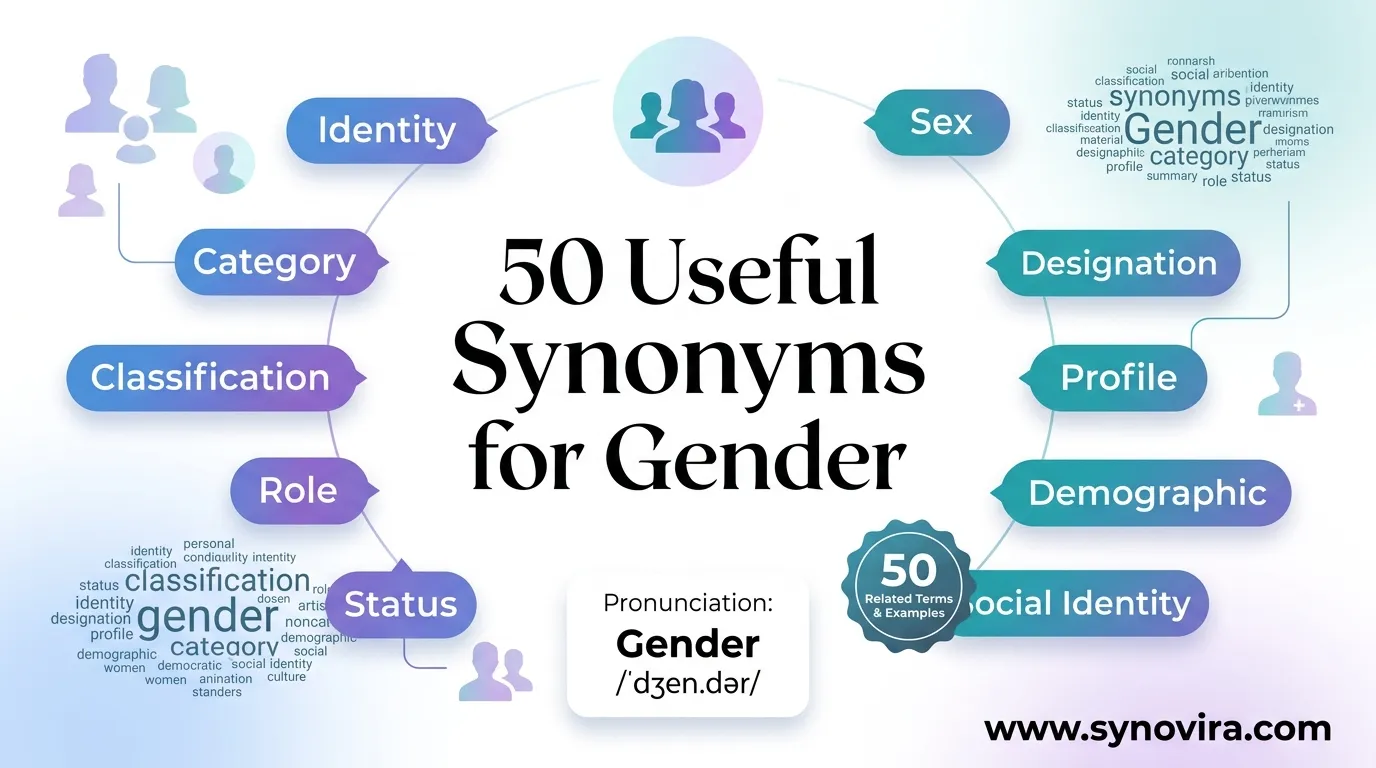
Identity • Sex • Classification • Category • Role
✨ Next 5 Synonyms for Gender ✨
Group • Type • Status • Designation • Profile
Pronunciation of “Gender”
Phonetic Spelling: jen-der
IPA Format: /ˈdʒen.dər/
Simple Breakdown: Gen + der
Syllables of “Gender”
Gender = 2 syllables
Gen – der
A syllable is a part of a word that we say in one beat. Gender has two easy parts.
When to Use Gender
Use the word gender when talking about:
- Identity and self-expression
- Social roles
- Equality discussions
- Surveys and forms
- Education and research
- Diversity and inclusion topics
Comparison Table: Gender Synonyms
| Word | Meaning | Common Usage |
| Identity | Who someone is | Personal identity |
| Sex | Biological classification | Medical contexts |
| Category | A group or class | Surveys |
| Classification | System of grouping | Research |
| Role | Social position | Society |
| Status | Condition or position | Records |
| Designation | Official label | Documentation |
| Type | Kind or group | General use |
| Group | Collection of people | Statistics |
| Profile | Personal description | User data |
List of 50 Gender Synonyms
Identity
Meaning
The way a person sees themselves.
Examples
- Identity is important to everyone.
- She proudly shared her identity.
Sex
Meaning
A biological classification of a person.
Examples
- The form asked for sex.
- Doctors may record sex information.
Category
Meaning
A group with similar features.
Examples
- Gender can be a survey category.
- The report used several categories.
Classification
Meaning
A way of organizing people or things.
Examples
- The study used a classification system.
- Researchers checked the classification.
Role
Meaning
A position or function in society.
Examples
- Gender roles can change over time.
- He questioned traditional roles.
Group
Meaning
A collection of people together.
Examples
- The group discussed equality.
- Every group had a leader.
Type
Meaning
A kind or form of something.
Examples
- This type is common.
- Different types were listed.
Status
Meaning
A person’s condition or position.
Examples
- Status information was updated.
- Her status remained unchanged.
Designation
Meaning
An official label or title.
Examples
- The designation appeared on the form.
- They changed the designation.
Profile
Meaning
Information about a person.
Examples
- He edited his profile.
- The profile showed basic details.
Identity Marker
Meaning
A detail that helps identify someone.
Examples
- The form included identity markers.
- It was used for records.
Demographic
Meaning
A population characteristic.
Examples
- Gender is a demographic factor.
- Surveys collect demographic data.
Attribute
Meaning
A quality or characteristic.
Examples
- Gender can be an attribute.
- The system stores attributes.
Trait
Meaning
A feature of a person.
Examples
- Every trait matters.
- Researchers studied traits.
Characteristic
Meaning
A feature that describes someone.
Examples
- It is a common characteristic.
- The characteristic was recorded.
Label
Meaning
A word used to describe something.
Examples
- Some people dislike labels.
- The label was removed.
Classification Type
Meaning
A grouping category.
Examples
- The form used a classification type.
- It helped organize data.
Persona
Meaning
A person’s public identity.
Examples
- His persona seemed friendly.
- The persona matched the brand.
Social Identity
Meaning
Identity within society.
Examples
- Social identity shapes experiences.
- Everyone has a social identity.
Personal Identity
Meaning
How a person defines themselves.
Examples
- Personal identity is unique.
- She explored her personal identity.
Position
Meaning
A place or standing.
Examples
- The position changed over time.
- He respected every position.
Membership
Meaning
Being part of a group.
Examples
- Membership gives belonging.
- Her membership was renewed.
Classification Group
Meaning
A grouped category.
Examples
- The classification group was updated.
- Data entered the correct group.
Social Category
Meaning
A group in society.
Examples
- Gender is often a social category.
- The study compared categories.
Identifier
Meaning
Something used for identification.
Examples
- The identifier was stored safely.
- Forms use identifiers.
Descriptor
Meaning
A word that describes something.
Examples
- The descriptor helped readers.
- They selected a descriptor.
Segment
Meaning
A section of a larger group.
Examples
- One segment showed growth.
- The segment was analyzed.
Division
Meaning
A separation into groups.
Examples
- The division was clear.
- Data used a simple division.
Classification Label
Meaning
A grouping name.
Examples
- The classification label was updated.
- Users selected a label.
Category Marker
Meaning
A sign showing a category.
Examples
- The category marker was visible.
- It helped sorting.
Identity Category
Meaning
A group based on identity.
Examples
- The survey listed identity categories.
- People chose their category.
Social Group
Meaning
A group within society.
Examples
- Every social group is different.
- The social group met weekly.
Classification Marker
Meaning
A sign used for grouping.
Examples
- The marker appeared in records.
- Staff checked the marker.
Social Status
Meaning
A person’s place in society.
Examples
- Social status can change.
- The study measured social status.
Individual Identity
Meaning
A person’s unique identity.
Examples
- Individual identity matters.
- Respect individual identity.
Demographic Category
Meaning
A population grouping.
Examples
- Gender is a demographic category.
- Researchers used categories.
Personal Classification
Meaning
A personal grouping.
Examples
- The form requested classification.
- Personal classification remained private.
Identity Label
Meaning
A label linked to identity.
Examples
- She chose her identity label.
- The identity label felt right.
Self-Identification
Meaning
How a person identifies themselves.
Examples
- Self-identification is personal.
- Forms allow self-identification.
Identity Group
Meaning
A group sharing identities.
Examples
- The identity group met online.
- Everyone felt welcome.
Human Category
Meaning
A group of people.
Examples
- The human category was broad.
- Data used human categories.
Identity Type
Meaning
A form of identity.
Examples
- Many identity types exist.
- He selected an identity type.
Recognition Category
Meaning
A recognized grouping.
Examples
- The category was officially recognized.
- Recognition categories help studies.
Social Classification
Meaning
A system of social grouping.
Examples
- Social classification affects research.
- The report discussed classification.
Personal Status
Meaning
A person’s condition.
Examples
- Personal status changed recently.
- The form asked for status.
Identity Status
Meaning
A person’s identity position.
Examples
- Identity status can develop.
- Students studied identity status.
Population Group
Meaning
A group within a population.
Examples
- The population group was surveyed.
- Researchers compared groups.
Identity Descriptor
Meaning
A term describing identity.
Examples
- He selected an identity descriptor.
- The descriptor was respectful.
Social Identifier
Meaning
A marker used socially.
Examples
- The identifier appeared in records.
- Social identifiers vary.
Demographic Marker
Meaning
A characteristic used in statistics.
Examples
- Gender is a demographic marker.
- Researchers tracked markers.
Identity Classification
Meaning
A system for identity categories.
Examples
- The study used identity classification.
- Identity classification helped analysis.
FAQ Section
What is another word for gender?
Common alternatives include identity, sex, category, classification, and role. The best choice depends on the context.
Are gender and sex the same?
Not always. Sex usually refers to biological characteristics, while gender often refers to social or personal identity.
Why should writers learn synonyms for gender?
Using different words improves readability, avoids repetition, and makes content more engaging for readers.
Which synonym is most commonly used?
Identity is one of the most commonly used gender-related terms in modern writing and communication.
Conclusion
Learning synonyms for gender is a great way to improve your English vocabulary and communication skills. When you know different words related to gender, your writing becomes more natural, clear, and interesting.
These gender synonyms can help in essays, blogs, emails, school projects, social media captions, and daily conversations. They also help writers avoid repeating the same word again and again.
Whether you are looking for another word for gender, exploring gender alternatives, or learning words related to gender, practicing these terms can strengthen your language skills.
Keep reading, writing, and using new vocabulary every day. Small steps in learning English can lead to big improvements in confidence and communication.

I am a professional blogger and content writer specializing in synonyms. With a strong focus on research-based writing and clear communication, I creates high-quality content designed to inform, educate, and add long-term value for readers.I am committed to maintaining accuracy, consistency, and professionalism across all published work.